
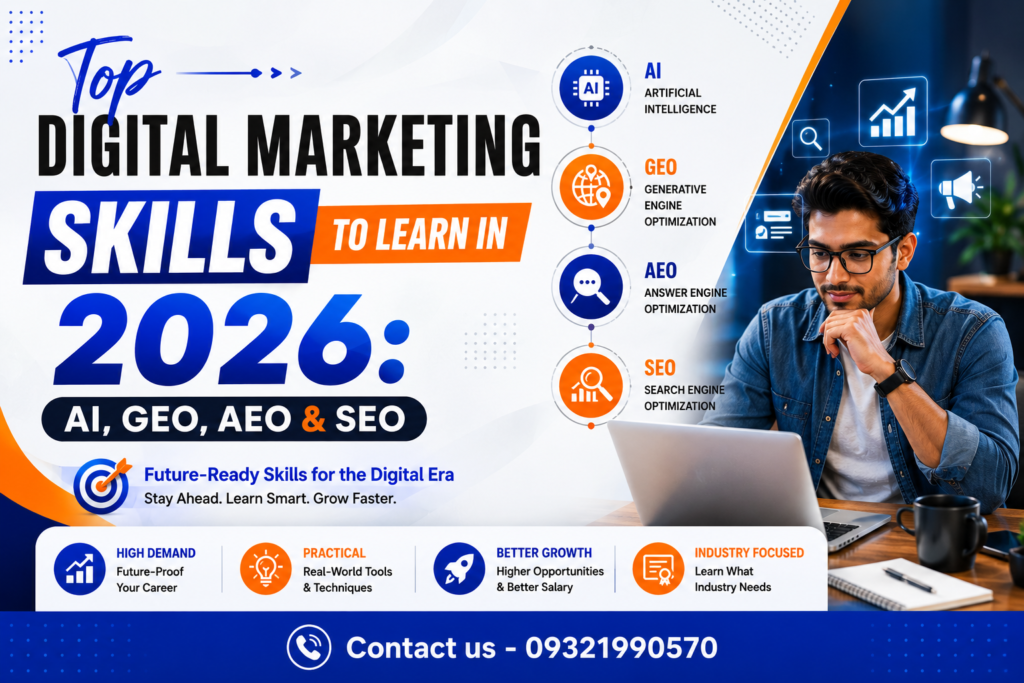
Digital marketing in 2026 looks very different from the industry students were preparing for only a few years ago. Search engines are becoming more conversational, artificial intelligence is assisting with everyday marketing tasks, advertising platforms rely increasingly on machine learning, and people are discovering information through a much wider range of platforms.
Traditional digital marketing skills have not disappeared. SEO, paid advertising, social media marketing, content strategy, analytics and website optimisation remain important. What has changed is how these skills are applied. A digital marketer today needs to understand not only how to rank a webpage on a conventional search engine results page, but also how to create useful information that can be understood, trusted and surfaced across AI-powered search experiences.
This is why terms such as Artificial Intelligence (AI), Generative Engine Optimization (GEO), Answer Engine Optimization (AEO), Search Engine Optimization (SEO) and AI Optimization are receiving greater attention.
Google’s current guidance makes an important point for marketers: SEO remains relevant to generative AI Search. Google also recognises AEO and GEO as terms commonly used for work focused on visibility in answer engines and generative search experiences, while emphasising that strong SEO fundamentals continue to form the foundation.
For students considering a Digital Marketing Course in Mumbai, this shift means learning individual tools is no longer enough. The more valuable ability is understanding how search, AI, content, advertising, user behaviour and data work together.
This guide explains the digital marketing skills worth developing in 2026 and how beginners can prepare for a marketing environment shaped by both traditional search and artificial intelligence.
What Are the Most Important Digital Marketing Skills to Learn in 2026?
The most important digital marketing skills in 2026 include SEO, AI-assisted marketing, GEO, AEO, content marketing, Google Ads, Meta Ads, social media marketing, analytics, WordPress, conversion optimisation, local SEO and marketing automation.
Students do not need to become specialists in every field immediately. However, they should understand how different digital channels connect.
For example, SEO helps a business gain organic visibility. Content marketing provides the information people are searching for. AEO helps organise that information into clear answers. GEO considers how useful content and entities may become discoverable within generative search experiences. Analytics helps marketers understand what visitors do after reaching a website. Paid advertising allows businesses to reach potential customers while organic visibility develops.
An effective 2026 skill set therefore combines:
- Search Engine Optimization
- Generative Engine Optimization concepts
- Answer Engine Optimization
- AI-assisted research and marketing
- Content strategy and copywriting
- Google Ads
- Meta Ads
- Social media marketing
- Google Analytics
- Google Search Console
- Local SEO
- Google Business Profile optimisation
- WordPress and landing pages
- Conversion Rate Optimization
- Email marketing
- Marketing automation
- Basic visual and video content creation
Rather than treating them as separate subjects, students should learn how these disciplines contribute to a complete customer journey.
Why Are Digital Marketing Skills Changing in 2026?
Digital marketing skills are changing because the way people search, compare, discover and purchase is changing.
A user may still type a keyword into Google, but another user might ask a detailed conversational question. Someone else might discover a brand through Instagram or YouTube, visit its website later and finally convert after seeing a remarketing advertisement.
AI has also become part of the marketer’s workflow. It can assist with research, idea generation, content outlines, ad variations, data interpretation and repetitive tasks. The marketer’s role therefore moves increasingly towards strategy, judgement, verification, creativity and decision-making.
Google has stated that people using its AI-powered Search experiences can ask longer and more complex questions. This makes comprehensive, useful content increasingly important rather than reducing the importance of good content.
Students should consequently move beyond learning only fixed techniques. They need to understand user intent, audiences, data, search behaviour and how to evaluate AI-generated suggestions.
The strongest marketers will not simply know which button to click. They will understand why a campaign, webpage or piece of content should exist and what business problem it is supposed to solve.
Which Digital Marketing Skills Are Most in Demand in 2026?
Digital marketing roles increasingly benefit from professionals who can combine a core specialisation with complementary skills.
SEO professionals, for example, benefit from understanding content, analytics, AI tools and conversion optimisation. Performance marketers need advertising skills but also landing-page optimisation, tracking, analytics and creative testing. Social media professionals increasingly need video, copywriting, analytics and paid distribution knowledge.
Some particularly useful skill combinations in 2026 are:
SEO + Content + GEO + AEO: Useful for organic visibility and AI-search-focused content strategies.
Google Ads + Analytics + CRO: Valuable for performance marketing and lead generation.
Social Media + Meta Ads + Short-Form Video: Useful for brand growth, engagement and social acquisition.
WordPress + SEO + Content: Valuable for freelancers, small businesses and website-focused marketers.
AI + Marketing Strategy + Analytics: Helpful across almost every modern digital marketing specialisation.
For beginners, the objective should not be collecting certificates for dozens of tools. It should be developing enough practical ability to execute marketing work independently, measure the outcome and explain why a strategy worked or failed.
Why Should Digital Marketers Learn AI Skills in 2026?
Digital marketers should learn AI because it can improve research, productivity, experimentation and analysis when used with human judgement.
AI can support marketers while performing tasks such as:
- Researching audience questions
- Generating topic ideas
- Creating first-draft content outlines
- Developing advertising variations
- Summarising large amounts of information
- Categorising keyword intent
- Brainstorming campaign concepts
- Analysing qualitative feedback
- Creating content briefs
- Repurposing information for different platforms
But using AI effectively requires more than entering a basic prompt.
A marketer needs to check sources, identify incorrect information, add real expertise, adapt content to a particular audience and ensure the final output serves a genuine purpose.
Google explicitly warns that using generative AI to create large volumes of pages without adding value can conflict with its spam policies. At the same time, Google acknowledges that generative AI can be useful for research and structuring original content.
Therefore, the valuable skill is not simply “using AI.” It is knowing when to use it, what to ask, how to verify the result and how to improve it with human insight.
What AI Skills Should Digital Marketing Students Learn in 2026?
Students should first learn AI skills that support practical marketing work rather than trying to become machine-learning engineers.
Important areas include prompt writing, research, fact verification, content planning, automation, AI-assisted analysis and responsible content editing.
A student should know how to provide an AI system with context such as:
- Target audience
- Business objective
- Search intent
- Brand guidelines
- Product or service information
- Desired output
- Restrictions
- Examples
- Supporting data
Students should also learn how to evaluate the answer rather than accepting everything an AI system produces.
For SEO, this may involve checking whether suggested keywords match real search intent. For content writing, it means identifying generic statements and replacing them with useful examples or original expertise. For paid advertising, AI-generated copy must still be reviewed for accuracy and relevance.
AI literacy should therefore include prompting, editing, critical thinking and verification.
Those four abilities are more durable than memorising a collection of commands for one particular AI application.
Which AI Tools Should Digital Marketers Learn in 2026?
Rather than trying every new application that appears, digital marketers should learn a small group of tools relevant to their actual work.
A practical toolkit can include:
ChatGPT: Useful for research assistance, brainstorming, content structuring, ideation and marketing workflows.
Google Gemini: Useful for AI-assisted research, ideation and working within Google’s broader ecosystem.
Canva AI features: Helpful for marketers creating graphics, presentations and social content.
Google Ads: Modern campaign management increasingly combines marketer inputs with automated bidding, targeting and creative capabilities.
Google Analytics: Essential for understanding traffic, user behaviour and campaign performance.
Google Search Console: Important for monitoring organic search visibility, indexing and query performance.
Students should also learn conventional SEO, social scheduling, email marketing, CRM and keyword research tools relevant to the type of work they want to perform.
The goal is tool adaptability. Platforms change rapidly. A marketer who understands audience research, campaign structure, conversion tracking and content strategy can adapt when interfaces and software change.
DGmark Institute‘s current published curriculum includes AI tools alongside AIO, GEO, AEO, SEO, Google Ads, Search Console, analytics and other digital marketing modules.
What Is Generative Engine Optimization (GEO) in Digital Marketing?
Generative Engine Optimization, or GEO, generally refers to improving the likelihood that useful information about a website, brand or topic can be understood and surfaced within generative AI search experiences.
GEO should not be treated as a magic method for forcing AI systems to mention a website.
A sensible GEO approach begins with many of the same qualities associated with strong SEO:
- Clear topical relevance
- Useful original information
- Accurate facts
- Logical website structure
- Descriptive headings
- Strong internal linking
- Consistent entity information
- Crawlable webpages
- Trustworthy sources
- First-hand expertise where appropriate
- Structured information
- Supporting images and video where useful
For example, a website explaining digital marketing courses should not create dozens of thin pages repeating the same definition. It should provide information that genuinely answers students’ questions about eligibility, skills, tools, learning methods, career opportunities and course selection.
Google currently describes GEO as a term used for work focused on visibility in AI search experiences but advises website owners to continue focusing on foundational SEO and valuable, unique content rather than supposed generative-search “hacks.”
Why Is GEO Important for Digital Marketers in 2026?
GEO matters because information discovery is increasingly extending beyond the traditional list of blue search results.
Users can ask detailed questions and receive generated responses that bring together information from different web sources. That means digital marketers should think about whether their content is clear enough to understand, useful enough to reference and trustworthy enough to support an answer.
However, GEO does not mean abandoning Google SEO.
Instead, marketers should build content that serves both human readers and modern search experiences.
A strong approach includes:
- Answer the user’s main question early.
- Expand the answer with genuine depth.
- Use descriptive headings.
- Support important claims.
- Maintain accurate brand and business information.
- Build relevant internal links.
- Make important pages crawlable and indexable.
- Include original expertise or examples.
- Update outdated information.
- Avoid creating repetitive AI-generated pages.
For local institutes and businesses, consistent business information also matters. Google notes that business information from sources such as Google Business Profiles can contribute to visibility across conventional and AI-powered Search experiences.
What Is Answer Engine Optimization (AEO) and Why Does It Matter?
Answer Engine Optimization (AEO) is the practice of creating and structuring information so that a user’s question can be answered clearly and efficiently.
An AEO-friendly page does not bury the answer beneath several paragraphs of unnecessary introduction.
For example:
Question: Can beginners learn digital marketing?
Direct answer: Yes. Beginners can learn digital marketing without previous marketing or coding experience. They should usually begin with marketing fundamentals, websites, SEO, content and analytics before progressing to specialised areas.
The answer can then be expanded.
This structure benefits readers because they get useful information immediately while still having the option to explore more detail.
Common AEO techniques include:
- Question-based headings
- Concise introductory answers
- Definitions
- Step-by-step explanations
- Comparison sections
- Relevant FAQs
- Lists
- Tables when comparison genuinely helps
- Clear entity and topic relationships
AEO should therefore improve communication rather than merely add more question headings.
What Is the Difference Between SEO, AEO and GEO?
SEO, AEO and GEO overlap, but they emphasise different parts of digital discovery.
SEO — Search Engine Optimization
SEO focuses on improving a website’s organic discoverability through search engines. It includes keyword research, technical SEO, content optimisation, internal linking, backlinks, user experience, crawling and indexing.
AEO — Answer Engine Optimization
AEO focuses more specifically on providing clear answers to questions. It encourages marketers to organise content around user queries, definitions and easy-to-understand responses.
GEO — Generative Engine Optimization
GEO is commonly used to describe efforts to improve visibility or usefulness within generative AI search experiences.
In practice, marketers should not build three completely separate strategies.
Google’s current guidance states that its generative AI Search experiences are rooted in core Search ranking and quality systems. From Google’s perspective, work described as AEO or GEO still depends strongly on established SEO principles.
A strong 2026 strategy can therefore be summarised as:
SEO helps information get discovered.
AEO helps information answer questions clearly.
GEO considers how that useful information performs in generative discovery experiences.
Is SEO Still an Important Digital Marketing Skill in 2026?
Yes. SEO remains one of the fundamental digital marketing skills in 2026.
AI search has changed how some results are presented, but websites still need to be discovered, crawled, understood and indexed.
Students learning SEO should understand:
- Keyword research
- Search intent
- On-page SEO
- Technical SEO basics
- Content optimisation
- Internal linking
- Website architecture
- Local SEO
- Google Search Console
- Search performance analysis
- Link earning
- E-E-A-T-related content quality principles
- User experience
- Image and video optimisation
Google explicitly states that SEO best practices remain relevant to generative AI Search because features such as AI Overviews and AI Mode are connected to Google’s existing Search systems.
That makes SEO a foundation rather than an outdated skill.
Students considering a Digital Marketing Course in Mumbai should therefore look for training that teaches both established SEO principles and how search behaviour is evolving with AI.
How Is SEO Changing Because of AI Search and Google AI Overviews?
SEO is becoming more focused on satisfying complex information needs rather than simply targeting short keyword phrases.
For years, marketers often planned content around individual keywords. Modern search requires a broader understanding of topics, entities, context and intent.
A user may search:
“digital marketing course”
But another may ask:
“Which digital marketing skills should I learn after graduation if I want an agency job in Mumbai?”
The second query contains several layers of intent.
Content designed for these searches needs more than keyword repetition. It needs a clear, trustworthy and comprehensive answer.
Google recommends creating helpful, reliable, people-first information and encourages site owners to consider whether readers will leave a page feeling they have learned enough to achieve their goal.
For marketers, this means prioritising:
- Intent over keyword density
- Unique value over generic summaries
- First-hand insight over rewritten information
- Logical structure over forced optimisation
- Original examples over commodity content
- Strong technical foundations
- Multimedia when it genuinely improves understanding
AI is changing SEO, but it is not removing the need for SEO fundamentals.
Is Prompt Engineering an Important Skill for Digital Marketers?
Prompt engineering is useful for digital marketers, although marketers do not need to become technical prompt engineers.
The practical skill is giving AI enough context to produce useful work.
Compare these prompts:
“Write Instagram content.”
and:
“Create five educational Instagram post concepts for Mumbai students considering digital marketing after graduation. Each concept should address one career-related question, avoid exaggerated salary claims and include a simple visual idea.”
The second instruction produces a more useful result because the audience, format, objective and constraints are defined.
Students can learn a simple prompt framework:
Context → Objective → Audience → Input → Constraints → Output Format → Review
The final step—review—is particularly important.
Marketers remain responsible for verifying statistics, correcting inaccurate information, protecting brand tone and deciding whether an AI-generated idea actually makes sense.
Prompting should therefore be taught as part of marketing judgement rather than as a replacement for it.
Which Digital Marketing Skills Should Beginners Learn First?
Beginners should build foundational skills before moving into advanced AI-search concepts.
A sensible learning sequence is:
1. Digital Marketing Fundamentals
Understand funnels, audiences, objectives, channels and customer journeys.
2. Website and WordPress Basics
Learn how webpages are created, structured and updated.
3. SEO
Understand keywords, search intent, content optimisation and Search Console.
4. Content Marketing
Learn how to research, write and structure useful information.
5. Social Media Marketing
Understand platform strategy, creative formats and audience engagement.
6. Google Ads and Meta Ads
Learn campaign objectives, targeting, budgets and optimisation.
7. Analytics and Tracking
Understand traffic, events, conversions and performance measurement.
8. AI Tools and Prompting
Use AI to support—not replace—the above skills.
9. AEO and GEO
Learn how traditional search principles extend into question-based and generative discovery.
This sequence gives beginners the context needed to understand why newer concepts matter.
Can Beginners Learn AI, SEO, GEO and AEO Without Coding?
Yes. Beginners can learn the practical marketing aspects of AI, SEO, GEO and AEO without being programmers.
SEO requires understanding websites, but most entry-level work does not require advanced software development.
Students can learn WordPress, keyword research, on-page optimisation, content planning, Search Console, analytics and basic technical checks without writing complex code.
Similarly, AEO primarily involves understanding user questions and structuring useful answers. GEO requires knowledge of content quality, entities, search visibility, website structure and related optimisation concepts rather than machine-learning programming.
Some technical knowledge becomes useful as students progress. Understanding basic HTML elements, schema concepts, tracking scripts and website performance can make an SEO professional more capable.
Coding is therefore an advantage for certain advanced roles, but it is not a compulsory starting point for learning digital marketing.
This is particularly relevant for students exploring a Digital Marketing Course in Andheri or elsewhere in Mumbai who come from commerce, arts, management or other non-technical backgrounds.
Which Digital Marketing Skills Can Help You Get a Job in 2026?
The skills that improve employability are usually the ones students can demonstrate through practical work.
Knowing the definition of SEO is less valuable than being able to audit a webpage, identify search intent, optimise its content and track what happens afterwards.
Similarly, completing a Google Ads lesson is different from understanding how to structure a campaign, select relevant targeting, interpret results and improve performance.
Students preparing for entry-level opportunities should try to build practical experience around:
- SEO audits
- Keyword research
- Website optimisation
- WordPress
- Content briefs
- Google Search Console
- Google Analytics
- Social media planning
- Meta Ads
- Google Ads
- Local SEO
- AI-assisted workflows
- Marketing reports
- Competitor analysis
- Landing-page evaluation
Portfolio evidence is especially useful. Students can document projects showing the problem, strategy, implementation and result.
Even when a campaign does not produce a spectacular result, being able to explain what was tested, what the data showed and what should happen next demonstrates practical thinking.
Is a Digital Marketing Course Worth Joining in 2026?
A digital marketing course can be worth joining in 2026 when it provides structured learning, practical implementation and exposure to current marketing workflows.
Digital marketing can also be self-taught. There are extensive resources available online. The challenge for many beginners is deciding what to learn first, separating outdated advice from current practices and finding opportunities to apply what they study.
A useful course should therefore provide more than recorded definitions.
Students evaluating a Digital Marketing Course in Mumbai should ask:
- Is the curriculum updated regularly?
- Does it include practical assignments?
- Will I work on websites or campaigns?
- Does it cover SEO and paid media?
- Are AI tools incorporated into practical exercises?
- Does it explain AEO and GEO in the context of SEO?
- Will I learn analytics and performance measurement?
- Can I build projects for a portfolio?
- Are concepts demonstrated rather than simply described?
- Does the programme match my career objective?
Location may also matter for classroom learners. Someone living in the western suburbs may compare a Digital Marketing Course in Andheri, a Digital Marketing Course in Borivali, Goregaon-based training or other Mumbai options based on travel time, batch schedules and learning format.
The best choice is the course that helps the learner build usable skills rather than simply completing a syllabus.
Why Learn AI, GEO, AEO and SEO at DGmark Institute?
Students considering DGmark Institute can evaluate it based on the practical skills included in its current published curriculum rather than only on broad marketing claims.
DGmark Institute’s current course information includes modules covering SEO, AIO (AI Optimization), GEO, AEO, Search Experience Optimization, Google Ads, Google Tag Manager, e-commerce website creation and other digital marketing areas. Its website also describes a practical, assignment-based approach to learning.
This combination is relevant because AI-era marketing should not be taught separately from core digital marketing.
A learner needs to understand SEO before evaluating GEO strategies. They need content fundamentals before creating answer-focused content. They need analytics before deciding whether an AI-assisted campaign is performing successfully.
For Mumbai students, DGmark Institute currently has course information for its Andheri, Borivali and Goregaon centres.
Students searching for a Digital Marketing Course in Andheri can therefore compare the institute’s classroom location, curriculum and practical learning structure against other available options.
Similarly, learners searching for a Digital Marketing Course in Borivali can examine whether the curriculum, batch format and hands-on approach suit their career plans.
For students comparing a broader Digital Marketing Course in Mumbai, the more important question is not simply which institute teaches the largest number of tools. It is whether students get enough practical exposure to understand how SEO, AI, content, advertising, analytics, GEO and AEO connect in real marketing work.
That ability to connect different skills is likely to remain more valuable than knowing a long list of software names.
Frequently Asked Questions
1. What are the top digital marketing skills to learn in 2026?
SEO, AI-assisted marketing, content marketing, GEO, AEO, Google Ads, Meta Ads, analytics, social media marketing, local SEO, WordPress and conversion optimisation are among the most useful skills to develop. Beginners should first build strong marketing fundamentals and then move towards specialised areas.
2. Is SEO worth learning in 2026?
Yes. SEO remains relevant because websites still need to be crawled, understood, indexed and connected with users’ searches. Google also confirms that foundational SEO practices continue to matter for its generative AI Search experiences.
3. What is GEO in digital marketing?
GEO stands for Generative Engine Optimization. It is commonly used to describe optimisation focused on improving visibility and usefulness within generative AI search experiences. Strong GEO practices overlap significantly with quality content, technical SEO, entity clarity and conventional search optimisation.
4. What is AEO in digital marketing?
AEO stands for Answer Engine Optimization. It focuses on structuring information so that users can receive clear and direct answers to their questions. Question-based headings, concise definitions, lists, FAQs and logically organised content can support an AEO strategy.
5. What is the difference between GEO and SEO?
SEO is the broader discipline of improving organic search visibility, while GEO usually refers specifically to visibility within generative AI search experiences. They should not be treated as completely separate disciplines because effective GEO generally relies on strong SEO foundations.
6. Do digital marketers need to learn AI?
Digital marketers do not need to become AI engineers, but learning how to use AI responsibly for research, ideation, analysis and workflow assistance is increasingly useful. Human judgement, strategy, creativity and verification remain essential.
7. Can I learn digital marketing without coding?
Yes. Most beginner digital marketing areas, including SEO, content, social media, advertising and analytics, can be learned without advanced coding. Basic HTML and technical website knowledge can become useful later, particularly for technical SEO.
8. Which digital marketing skill should a beginner learn first?
Start with digital marketing fundamentals, websites, SEO and content marketing. Once these foundations are clear, learn social media, advertising, analytics, AI tools, AEO and GEO.
9. Which digital marketing skills are best for getting a job?
SEO, Google Ads, Meta Ads, analytics, content marketing, social media marketing and WordPress can support many entry-level opportunities. Practical projects, campaign understanding and the ability to analyse performance are often more valuable than theoretical knowledge alone.
10. Where can I learn AI, GEO, AEO and SEO in Mumbai?
Students can compare digital marketing institutes based on curriculum, practical assignments, trainers, location and learning format. DGmark Institute’s currently published curriculum includes SEO, AIO, GEO and AEO alongside other digital marketing modules, with course options listed across Mumbai locations including Andheri, Borivali and Goregaon.
Conclusion
Digital marketing in 2026 is not becoming less relevant because of AI; it is becoming broader. SEO remains important, but search marketers now need to understand how user behaviour is evolving through conversational and AI-powered discovery. AEO encourages marketers to answer questions more clearly. GEO introduces a useful way of thinking about visibility within generative experiences. AI tools can improve productivity, but only when marketers have enough knowledge to guide, verify and improve their output.
For students, the strongest approach is therefore not to chase every new trend. Build strong foundations in SEO, content, websites, analytics, paid advertising and audience understanding. Then learn how AI, GEO, AEO, automation and modern search experiences connect with those foundations.
Students considering a Digital Marketing Course in Mumbai, including a Digital Marketing Course in Andheri or Digital Marketing Course in Borivali, should evaluate programmes based on practical learning, curriculum relevance and the opportunity to apply skills to real marketing situations.
DGmark Institute’s published curriculum currently incorporates traditional digital marketing subjects alongside AI-focused topics, GEO and AEO, reflecting how the field is developing. The tools used by marketers will continue to change. Search interfaces will continue to evolve. New AI platforms will appear.
But the marketers who understand people, search intent, useful content, data, strategy and business outcomes will be in the strongest position to adapt. That is the real digital marketing skill to build for 2026 and beyond.
Contact DGmark Institute Today!
Goregaon Branch
DGmark Institute – Digital Marketing Courses in Mumbai
Address: 23, Ground Floor, Harmony Mall, New Link Rd, Sejal Park, Colony No 1, Bhagat Singh II, Goregaon West, Mumbai, Maharashtra 400104
Phone no: 09321990570
Website: https://dgmarkinstitute.com/digital-marketing-courses-goregaon-mumbai/
Get Direction: https://maps.app.goo.gl/Dqcp3yWdJH989f9U9
Andheri Branch
DGmark Institute Andheri – Digital Marketing Courses in Andheri, Mumbai
Address: 402, Pratik Apartment B Wing, Opp Dhake Colony, Apna Bazaar, JP Rd, above Arihant Academy, Andheri West, Mumbai, Maharashtra 400053
Phone no: 09833240570
Website: https://dgmarkinstitute.com/digital-marketing-courses-in-andheri-mumbai/
Get Direction: https://maps.app.goo.gl/kBwYRafR79NQXToUA
Borivali Branch
DGmark Institute Borivali – Digital Marketing Courses in Borivali, Mumbai
Address: 11, bldg no. 3, Shree, Swami Vivekanand Rd, opp. Kalyan Jewellers, near FM Cariappa Flyover, Ram Krishna Nagar, Borivali West, Mumbai, Maharashtra 400092
Phone no: 09833540570
Website: https://dgmarkinstitute.com/digital-marketing-courses-in-borivali-mumbai/
Get Direction: https://maps.app.goo.gl/wDV8tffvxP9LWvLj7