
Introduction
In 2026, generating quality leads through digital advertising has become an important priority for businesses looking to increase enquiries, attract customers, and improve online sales. Whether a company offers professional services, educational courses, healthcare services, real estate solutions, or consumer products, choosing the right advertising platform can significantly influence its marketing performance. Google Ads and Meta Ads are two widely used paid advertising platforms, but they operate differently in terms of customer targeting, audience behaviour, advertising formats, and lead generation strategies.
Many business owners face a common question: Google Ads vs Meta Ads—which platform generates better leads in 2026? The answer depends on business objectives, customer search intent, available advertising budgets, and the nature of the products or services being promoted. Google Ads can help businesses reach customers actively searching for solutions, while Meta Ads enables advertisers to reach potential customers through Facebook, Instagram, and other eligible Meta placements. Both platforms offer opportunities for lead generation, but the quality and commercial value of those leads may differ.
For small businesses, selecting an advertising platform is not simply about generating more clicks or reducing the cost per lead. It involves understanding customer behaviour, developing effective campaigns, improving conversion rates, and measuring how advertising enquiries contribute to actual sales. Businesses must also consider AI-powered advertising, automated bidding, creative quality, and conversion tracking when evaluating the performance of Google Ads and Meta Ads.
DGmark Agency, a digital marketing company in Mumbai, provides paid advertising services for Google, Facebook, and Instagram, alongside SEO, website development, and social media marketing. The agency also serves businesses targeting customers in locations such as Borivali and Andheri. This guide explores the differences between Google Ads and Meta Ads, helping businesses understand lead quality, advertising costs, ROI, targeting options, and which platform is more suitable for their marketing requirements in 2026.
What Is the Difference Between Google Ads and Meta Ads in 2026?
The main difference between Google Ads and Meta Ads lies in how businesses connect with potential customers. Google Ads, particularly Search campaigns, allows businesses to reach users who are actively searching for products, services, or information. Meta Ads focuses heavily on reaching audiences through Facebook and Instagram based on relevant signals, platform activity, creative engagement, and automated delivery. Both platforms can generate leads, but they frequently reach customers at different stages of the purchasing journey.
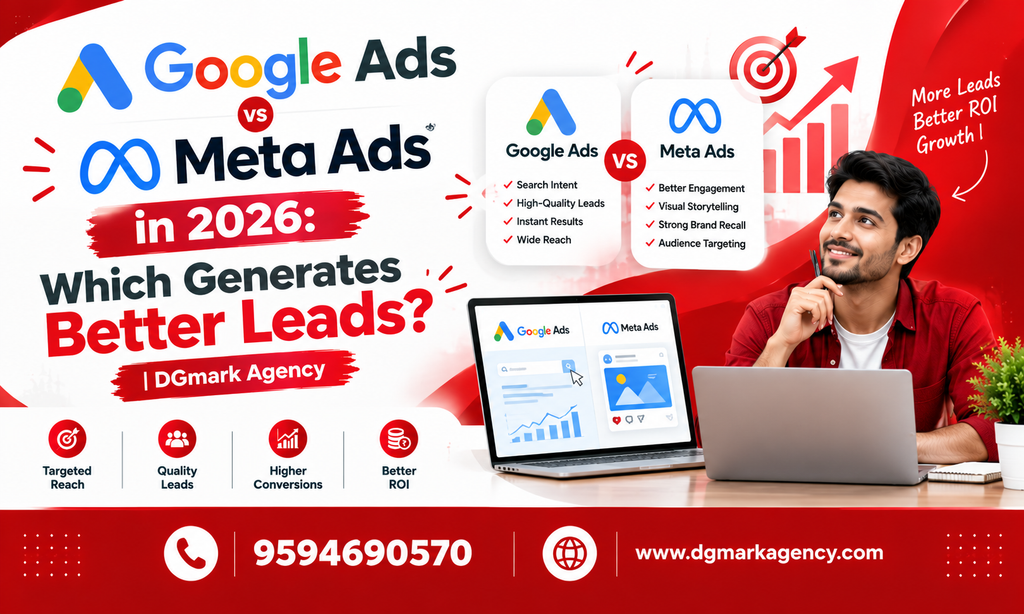
Google Ads vs Meta Ads: Key Differences
| Comparison Factor | Google Ads | Meta Ads |
|---|---|---|
| Primary opportunity | Capture existing search demand | Generate interest and demand |
| Major platforms | Google Search, YouTube, Maps and other eligible channels | Facebook, Instagram and other eligible Meta placements |
| Customer intent | Often high for commercial searches | Varies by audience and campaign |
| Common ad formats | Search, image, video, product ads | Image, carousel, video, Stories, Reels |
| Lead generation | Website forms, calls, lead forms | Instant forms, website forms, messaging |
| Targeting approach | Keywords, intent signals, audiences | Audience signals, engagement, automation |
| Creative importance | Messaging and relevance | Visual quality and messaging |
| Main strength | Reaching existing demand | Reaching and developing demand |
Google Search Ads can be particularly effective when a customer already knows what they want. Meta Ads can be useful when a business needs to introduce an offering, demonstrate its benefits, or build interest before customers begin searching. Neither platform is automatically better. The most appropriate choice depends on the purchasing journey and the quality of leads required.
How Do Google Ads and Meta Ads Work for Small Business Lead Generation?
Google Ads and Meta Ads help businesses reach potential customers through different advertising mechanisms. Google Search campaigns connect advertisements with relevant searches, while Meta campaigns can introduce offers through visually engaging placements and automated audience delivery. Both platforms can encourage users to complete enquiry forms, contact businesses, request appointments, or make purchases. Effective lead generation depends on selecting suitable objectives and providing an easy path from advertisement interaction to customer enquiry.
How Both Platforms Generate Leads
- Google Search Ads: Reach customers using keywords associated with relevant purchasing needs.
- Google lead forms: Collect enquiries through eligible advertising formats.
- Google call-focused advertising: Encourage suitable customers to contact the business.
- Meta Instant Forms: Allow users to submit information within eligible Meta advertising experiences.
- Meta website campaigns: Send interested users to a landing page for further information.
- Click-to-message advertising: Encourage conversations through supported messaging destinations.
- Conversion optimisation: Use performance signals to improve delivery towards selected outcomes.
For example, a customer actively searching for a local service may respond well to a relevant Google Search advertisement. Another customer may discover that service through an informative Instagram Reel or Facebook advertisement before considering an enquiry. Businesses should understand these behavioural differences when building their lead generation strategy.
Google Ads vs Meta Ads: Which Platform Generates More Quality Leads?
Google Ads often has an advantage when customers are actively looking for a particular solution, especially through commercially focused Search campaigns. Meta Ads can generate enquiries from people who have not yet started searching but may become interested after seeing a relevant advertisement. However, high search intent does not guarantee that every Google lead will convert, and Meta leads should not automatically be considered lower quality. Actual lead quality depends on targeting, advertising messages, qualification methods, and customer readiness.
Factors That Determine Lead Quality
- Customer intent: Understand whether the prospect is actively searching or exploring an offer.
- Service relevance: Ensure the advertisement accurately represents the business offering.
- Lead qualification: Collect useful information to distinguish suitable prospects.
- Customer readiness: Identify whether the person is prepared to purchase or requires further consideration.
- Sales response: Provide timely communication after receiving an enquiry.
- Conversion tracking: Measure which leads progress towards genuine customer relationships.
- Customer value: Compare advertising costs with the revenue potential of acquired customers.
For businesses selling urgent or clearly defined services, Google Search Ads may attract more purchase-ready prospects. For products requiring visual demonstration or early awareness, Meta Ads may be useful for developing customer interest. The winning platform should be determined by qualified lead-to-customer conversion rates and acquisition costs, not simply the number of enquiry forms submitted.
Which Is Better for Small Businesses: Google Ads or Facebook Ads?
For small businesses, the choice between Google Ads and Facebook Ads depends on whether customers are already searching for the offering or need to discover it first. Google Ads can help businesses appear when customers express relevant needs through search. Facebook Ads, managed within Meta Ads, provides opportunities to engage audiences through informative visuals, videos, customer stories, and service demonstrations. Both approaches can contribute to business growth when aligned with clear marketing objectives.
When Each Platform May Be More Suitable
- Local professional services: Google Search Ads may help capture existing customer demand.
- Fashion and lifestyle brands: Facebook and Instagram advertising can demonstrate products visually.
- Home improvement services: Both platforms may support research, discovery, and enquiries.
- Educational institutes: Search advertising can capture course-related queries, while Meta can build interest.
- Real estate businesses: Search campaigns and visual property advertisements can complement each other.
- New product launches: Meta advertising can help introduce offerings to relevant audiences.
- Urgent service requirements: Google Search may be especially useful when customers need immediate assistance.
Small businesses should avoid selecting a platform solely because one appears cheaper. The decision should consider customer behaviour, sales margins, service availability, and creative resources. A business with limited marketing funds may initially prioritise the platform most closely aligned with its customers’ purchasing intentions before expanding to additional channels.
Google Ads vs Meta Ads: Which Platform Is More Cost-Effective in 2026?
Cost-effectiveness cannot be determined by advertising expenses alone. Meta Ads may produce lower costs for certain types of initial enquiries, while Google Search Ads can attract customers with stronger existing purchasing intent. However, these patterns are not universal. An inexpensive lead that never becomes a customer can be less valuable than a more expensive enquiry that results in a profitable sale. Businesses must compare acquisition costs with lead quality and customer revenue.
Factors Affecting Advertising Cost-Effectiveness
- Industry competition: Competitive markets can increase advertising costs on either platform.
- Customer targeting: Relevant targeting helps reduce expenditure on unsuitable audiences.
- Advertisement quality: Useful messages and effective creative assets influence engagement.
- Landing page experience: Website performance affects the value generated from advertising traffic.
- Conversion rate: Stronger conversion performance can improve acquisition efficiency.
- Lead qualification: Filtering unsuitable enquiries helps reveal the real cost of relevant prospects.
- Customer lifetime value: Repeat purchases can influence acceptable acquisition expenditure.
Rather than declaring Google Ads or Meta Ads universally cheaper, businesses should calculate the cost of acquiring a qualified customer through each platform. The most cost-effective advertising channel is the one that generates commercially valuable outcomes within a financially sustainable budget.
How Much Should Small Businesses Spend on Google Ads vs Meta Ads?
Small businesses should plan their Google Ads and Meta Ads budgets according to customer acquisition goals, market competition, and available financial resources. There is no fixed advertising budget suitable for every industry. Businesses offering specialised services may need to invest more in competitive commercial searches, while businesses promoting visually engaging products may prioritise Meta advertising. The important consideration is whether the chosen budget can support meaningful campaign testing without affecting business operations.
Important Factors for Advertising Budget Allocation
- Business objectives: Decide whether the campaign should generate calls, enquiries, bookings, or purchases.
- Audience demand: Evaluate whether customers actively search for the offering or discover it through advertising.
- Estimated advertising costs: Research relevant keyword auctions and audience competition.
- Profit margins: Understand how much can be spent to acquire a new customer.
- Creative requirements: Consider video, image, and landing page production costs.
- Testing needs: Allow resources to evaluate different messages and customer segments.
- Management expenses: Account for professional campaign management fees separately.
Businesses with limited budgets should avoid dividing expenditure equally between platforms without a clear reason. Instead, they can prioritise the channel that most closely matches customer purchasing behaviour. After collecting dependable conversion information, they can adjust allocations according to qualified leads, sales outcomes, and customer acquisition costs.
What Is the Average Cost Per Lead for Google Ads vs Meta Ads in India?
The average cost per lead for Google Ads and Meta Ads in India varies significantly across industries, service locations, campaign formats, and customer requirements. Google Search advertising may involve higher click costs in competitive sectors, while Meta lead forms can sometimes generate relatively inexpensive enquiries. However, comparing initial form submissions is insufficient when the quality of those enquiries differs. Industry benchmarks should be treated as indicative rather than universal market averages because actual campaign costs depend on many factors.
Factors Influencing Cost Per Lead in India
- Industry category: Real estate, education, healthcare, and professional services have different acquisition economics.
- Geographical targeting: Advertising competition varies between metropolitan and smaller markets.
- Search intent: Commercially valuable searches may attract higher bidding competition.
- Campaign format: Website conversions and instant forms can involve different levels of customer effort.
- Creative effectiveness: Strong advertisements may improve engagement and enquiry performance.
- Qualification requirements: More selective lead forms may reduce volume but improve relevance.
- Sales conversion rates: The percentage of leads becoming customers determines commercial value.
For Mumbai businesses, an appropriate cost per lead should be calculated using actual advertising expenditure and customer qualification data. Businesses should distinguish raw CPL from cost per qualified lead. A lower reported CPL does not necessarily mean an advertising platform delivers better business results, especially when enquiries are difficult to contact or have limited purchasing interest.
Which Platform Delivers Better ROI: Google Ads or Meta Ads?
The platform delivering better return on investment depends on how effectively advertising expenditure produces profitable customers. Google Ads may generate strong returns when businesses capture existing demand and convert enquiries efficiently. Meta Ads may produce valuable results when visual campaigns introduce products, build customer interest, and encourage subsequent purchases. Neither platform guarantees a higher ROI because performance depends on conversion quality, customer value, profit margins, and sales effectiveness.
Key Metrics for Comparing Google Ads and Meta Ads ROI
- Cost per lead (CPL): Advertising expenditure divided by generated enquiries.
- Cost per qualified lead: Spending divided by enquiries meeting defined customer criteria.
- Lead-to-customer conversion rate: Percentage of leads becoming paying customers.
- Customer acquisition cost (CAC): Total relevant acquisition expenses divided by acquired customers.
- Return on ad spend (ROAS): Advertising-attributed revenue divided by advertising expenditure.
- Return on investment (ROI): Net financial return compared with total relevant investment.
- Customer lifetime value: Revenue or contribution value generated across the customer relationship.
A business should also consider overlapping customer journeys. Someone may first discover a product through Instagram before searching for the company on Google and making a purchase. Platform reports may attribute value differently, so advertisers should combine campaign data with sales records and avoid automatically adding together overlapping attributed conversions.
How Does Audience Targeting Differ Between Google Ads and Meta Ads?
Audience targeting is one of the most important differences between Google Ads and Meta Ads. Google Search advertising is particularly useful for reaching people whose queries reveal a specific requirement. Meta advertising can reach people through audience characteristics, engagement signals, automated delivery, and eligible audience tools, even when they are not actively searching for a product. Both platforms use machine learning, but their available signals and advertising contexts differ.
Key Audience Targeting Differences
- Keyword targeting: Google Search campaigns can respond to relevant search phrases.
- Search intent: Customer queries can indicate immediate or emerging purchasing requirements.
- Geographical targeting: Both platforms offer location-related advertising controls.
- Audience signals: Google and Meta use eligible information to support campaign delivery.
- Custom audiences: Meta supports eligible audience creation using customer and engagement information.
- Remarketing: Both platforms provide methods for reconnecting with eligible previous audiences.
- Automated expansion: Their optimisation systems can identify additional conversion opportunities.
Businesses should choose targeting methods according to customer behaviour and the data available to them. For example, a local service provider may benefit from relevant Google searches, while a visual consumer brand may benefit from Meta’s discovery-oriented placements. Privacy requirements, platform restrictions, and audience eligibility must also be considered when using customer information for advertising.
Which Platform Is Better for High-Intent Leads: Google Ads or Meta Ads?
Google Search Ads are often well suited to attracting high-intent leads because customers express their needs through specific searches. Queries related to hiring a service provider, requesting quotations, or booking appointments may indicate that someone is evaluating a purchase. Meta Ads can also generate high-intent enquiries, particularly from engaged audiences or compelling offers, but advertisers may need to establish customer interest before the person is ready to buy.
Indicators of High-Intent Lead Generation
- Commercial search phrases: Keywords suggesting that customers are comparing providers or prices.
- Specific service requirements: Enquiries that clearly match the advertised offering.
- Customer readiness: Prospects who have a relevant need and a realistic purchasing timeline.
- Detailed enquiry information: Contact submissions that provide useful qualification details.
- Relevant geographical location: Prospects located within the serviceable market.
- Sales engagement: Customers who respond to follow-up and progress towards a decision.
- Purchase completion: Leads that eventually produce revenue for the business.
Businesses offering urgent services or products with established search demand may find Google Search especially relevant. Meta advertising can contribute to high-intent customer acquisition when the offer, creative message, and audience are appropriate. The more important measure is how leads progress through the sales process rather than which platform originally generated the enquiry.
Google Search Ads vs Facebook Lead Ads: Which Converts Better?
Google Search Ads and Facebook Lead Ads encourage customer enquiries through different experiences. Search Ads typically reach users responding to an existing need and may direct them to a website, contact action, or other eligible conversion destination. Facebook Lead Ads can use instant forms that reduce the effort needed to submit information. This convenience may increase submission volume, but it does not guarantee that every submission represents a serious prospect.
Important Conversion Factors to Compare
- Customer intent: Understand whether prospects are actively searching or responding to an advertisement.
- Form completion process: Evaluate how easily customers can submit relevant information.
- Landing page relevance: Ensure website content addresses customer expectations.
- Lead qualification: Ask useful questions that help identify suitable prospects.
- Contact accuracy: Review whether submitted customer details are usable.
- Response time: Ensure enquiries receive timely follow-up.
- Sales conversion: Measure which enquiries become actual customers.
Businesses should compare more than the initial form conversion rate. Facebook Lead Ads may generate submissions conveniently, while Search campaigns may attract people already evaluating a solution. The better campaign is the one that creates more commercially valuable customers at an acceptable acquisition cost.
Why Are Your Google Ads and Meta Ads Generating Clicks but No Leads?
Advertising campaigns may generate clicks without meaningful enquiries when there is a mismatch between customer expectations and the conversion experience. On Google Ads, this may occur when keywords attract unrelated searches or landing pages provide insufficient information. On Meta Ads, users may engage with attractive creative content without having genuine purchasing interest. Technical problems, unclear contact options, and inaccurate tracking can affect both platforms.
Common Reasons Paid Advertising Fails to Convert
- Incorrect campaign objective: Campaign delivery focuses on traffic rather than meaningful conversions.
- Irrelevant audiences: Advertisements reach users with limited purchasing interest.
- Weak advertising messages: Content attracts curiosity without explaining the business offering.
- Landing page mismatch: Visitors do not find the information promised in the advertisement.
- Complicated forms: Excessive questions discourage completion.
- Poor mobile experience: Contact processes are difficult to use on smartphones.
- Tracking problems: Genuine enquiries may not be recorded accurately.
- Slow customer response: Interested prospects disengage before receiving assistance.
Businesses should investigate the complete customer journey before increasing advertising budgets. Reviewing targeting, testing enquiry forms, checking mobile usability, and validating conversion tracking can reveal where performance is being lost. Once the underlying problem is identified, focused improvements can be made to encourage more relevant enquiries.
How Can Businesses Improve Lead Quality on Google Ads and Meta Ads?
Improving lead quality requires identifying customers who are genuinely interested in the business’s products or services and are reasonably likely to purchase. Campaigns should be designed around clear qualification criteria rather than simply generating maximum enquiry volume. Google Ads and Meta Ads both benefit from accurate advertising messages, reliable conversion measurement, and feedback from the sales team. Without these elements, automated systems may optimise towards low-value interactions.
Strategies to Improve Paid Advertising Lead Quality
- Define an ideal customer profile: Identify requirements, serviceability, and purchasing considerations.
- Develop accurate advertisements: Clearly describe the offering and avoid misleading promises.
- Refine keyword or audience targeting: Reduce exposure to unsuitable customer segments.
- Use relevant qualification questions: Collect essential details to assess prospective customers.
- Connect CRM records: Monitor which enquiries progress towards genuine opportunities.
- Track qualified conversions: Use appropriate downstream events to guide optimisation.
- Improve sales follow-up: Respond consistently and record customer outcomes.
- Review rejected leads: Identify recurring reasons prospects are unsuitable.
Businesses should create a feedback process between advertising management and sales teams. If a large proportion of leads have incorrect contact details, irrelevant requirements, or unrealistic expectations, the campaign may need adjustments. Reliable sales feedback helps advertisers improve creative messages, targeting decisions, conversion goals, and budget allocation.
What Are the Most Common Google Ads vs Meta Ads Mistakes to Avoid?
Advertising mistakes can reduce campaign efficiency on both Google Ads and Meta Ads, even when businesses have suitable products and sufficient budgets. A common problem is selecting campaign objectives that do not match commercial goals. Businesses may optimise for clicks, impressions, or inexpensive submissions without considering whether those interactions generate customers. Other issues include inadequate targeting, weak advertisements, tracking inaccuracies, and frequent changes made without sufficient data.
Common Paid Advertising Mistakes
- Choosing inappropriate objectives: Running traffic campaigns when qualified enquiries are the priority.
- Ignoring customer intent: Targeting audiences without considering purchasing behaviour.
- Using generic advertisements: Failing to communicate specific benefits or requirements.
- Neglecting landing pages: Sending visitors to websites that are slow or difficult to navigate.
- Tracking low-value actions: Treating every engagement as a meaningful conversion.
- Changing campaigns too frequently: Making decisions based on limited short-term information.
- Ignoring creative fatigue: Continuing ineffective advertisements without evaluating engagement.
- Comparing CPL alone: Overlooking customer quality and sales outcomes.
- Failing to qualify enquiries: Allowing sales teams to spend time on unsuitable prospects.
Businesses should regularly review campaign objectives, conversion tracking, lead quality, and customer acquisition costs. Advertising decisions should be supported by meaningful performance data rather than assumptions about which platform is better. A structured management process helps businesses reduce avoidable expenditure and maintain consistency across advertising campaigns.
How Is AI Changing Google Ads and Meta Ads Lead Generation in 2026?
Artificial intelligence plays an increasingly important role in paid advertising, helping platforms evaluate audience signals, adjust delivery, and identify conversion opportunities. Google Ads uses AI-powered features within its bidding and campaign optimisation systems, while Meta uses automation to support audience delivery, placements, budgets, and creative combinations. These capabilities can improve operational efficiency, but they depend on accurate objectives and reliable customer information.
AI-Powered Advertising Capabilities in 2026
- Automated bidding: Google evaluates eligible auction signals to support conversion objectives.
- Audience optimisation: Automated systems identify relevant delivery opportunities using available signals.
- Creative combinations: Platforms evaluate supported variations of advertising content.
- Conversion prediction: Machine learning estimates the likelihood of selected customer actions.
- Value-based optimisation: Eligible systems can prioritise higher-value conversion outcomes.
- Performance insights: Automated recommendations help identify possible improvements.
- First-party data integration: Appropriately collected customer information can support better measurement.
- Campaign efficiency: Automation reduces some repetitive management responsibilities.
Google’s Smart Bidding includes approaches such as Maximise Conversions, Target CPA, Maximise Conversion Value, and Target ROAS. AI should be viewed as a tool for implementing advertising strategy rather than replacing it. Businesses must continue evaluating lead quality, conversion accuracy, and customer acquisition costs to ensure automation supports commercial objectives.
Google Performance Max vs Meta Advantage+: Which Is Better for Lead Generation?
Google Performance Max and Meta Advantage+ provide automated campaign capabilities that support advertising delivery and conversion optimisation. Performance Max uses Google’s advertising inventory to identify opportunities across eligible channels, while Meta’s Advantage+ technologies support automation within its advertising ecosystem. Both can reduce some manual targeting and optimisation work, but they operate through different platforms and customer interactions.
Google Performance Max vs Meta Advantage+: Key Considerations
- Google Performance Max: Uses eligible Google channels to pursue selected conversion goals.
- Meta Advantage+: Supports automated campaign delivery, audience selection, placements, and other eligible optimisations.
- Customer behaviour: Google can capture search-related demand alongside other opportunities; Meta frequently reaches audiences during content discovery.
- Creative requirements: Both benefit from accurate, high-quality advertising assets.
- Conversion signals: Reliable customer actions help guide automated systems.
- Campaign monitoring: Advertisers should regularly review performance and business outcomes.
- Lead qualification: Sales information helps determine whether automation generates valuable customers.
Businesses using automated campaigns should provide meaningful conversion data, suitable creative assets, and information that helps the system understand valuable leads. The better automated advertising approach depends on the business’s customer journey and available performance information. Advertisers should evaluate actual qualified enquiries rather than assuming automation alone guarantees improved results.
Which Is Better for Local Business Advertising in Mumbai: Google Ads or Meta Ads?
For businesses targeting customers in Mumbai, selecting between Google Ads and Meta Ads requires understanding local search behaviour, geographical coverage, and customer purchasing intentions. Google Search campaigns can be useful when people actively look for nearby services, while Facebook and Instagram advertising can introduce businesses through engaging content. The most suitable platform depends on whether customers are searching for a service immediately or discovering new options.
Local Advertising Strategies for Mumbai Businesses
- Location-specific Search campaigns: Reach users looking for relevant services within target areas.
- Google Maps-related opportunities: Support eligible local advertising objectives.
- Facebook and Instagram campaigns: Introduce offerings through relevant visual advertisements.
- Neighbourhood-focused messaging: Address customer needs in areas such as Andheri and Borivali.
- Mobile-friendly landing pages: Make contact information convenient for smartphone users.
- Local service relevance: Clearly communicate operating areas and available offerings.
- Call and enquiry tracking: Measure meaningful customer interactions.
- Geographical performance analysis: Identify which areas produce suitable leads.
A business searching for a digital marketing agency in Borivali may want advertising that specifically reaches customers within its serviceable market. Similarly, a company evaluating a digital marketing agency in Andheri should consider how well the provider understands geographical targeting and local customer requirements. Mumbai businesses can benefit from aligning paid campaigns with genuine customer demand instead of using broad targeting without a clear strategy.
Should Small Businesses Use Google Ads and Meta Ads Together?
Using Google Ads and Meta Ads together can be valuable when a business has sufficient resources and customers interact with multiple advertising channels before making a decision. Meta campaigns can introduce a product or service to potential customers, while Google Search campaigns may reach people when they actively look for related solutions. However, combining platforms should be based on a defined strategy rather than dividing advertising budgets equally without evidence.
Benefits of a Combined Advertising Strategy
- Customer discovery: Meta campaigns can introduce offerings to relevant audiences.
- Search demand capture: Google Ads can reach customers actively searching for solutions.
- Multiple customer touchpoints: Businesses can maintain relevant visibility throughout the purchasing journey.
- Creative flexibility: Use search messages alongside image and video advertisements.
- Audience re-engagement: Use eligible remarketing opportunities where appropriate.
- Budget flexibility: Allocate spending according to platform performance and customer value.
- Lead source comparison: Review qualified enquiries and customer acquisition costs across channels.
- Marketing integration: Coordinate paid advertisements with SEO and website experiences.
Businesses should establish separate campaign objectives and reliable measurement for each platform. When a customer interacts with advertisements across both ecosystems, attribution reports may overlap. Sales information and customer acquisition analysis can provide a more reliable picture of performance than adding together every platform-reported conversion. Combining channels is most useful when each has a clear purpose.
How to Choose the Right Google Ads and Meta Ads Agency in Mumbai?
Choosing an advertising agency requires evaluating its understanding of campaign planning, audience targeting, creative development, conversion measurement, and customer acquisition. A suitable provider should explain how Google Ads and Meta Ads serve different purposes and how advertising strategies will be adapted to business requirements. Mumbai businesses should also consider whether the agency understands local markets and can report campaign performance transparently.
Important Factors When Selecting a Paid Advertising Agency
- Platform expertise: Evaluate experience with Google Ads and Meta Ads management.
- Relevant industry knowledge: Consider familiarity with similar business models.
- Campaign strategy: Understand how objectives, targeting, and advertising messages are developed.
- Creative capabilities: Assess experience producing relevant images, videos, and copy.
- Conversion tracking knowledge: Confirm the ability to measure meaningful customer actions.
- Transparent pricing: Request clear distinctions between advertising expenditure and management fees.
- Lead quality evaluation: Ask how qualified enquiries and customer acquisition are measured.
- Reporting practices: Review whether performance reports support informed decisions.
- Realistic expectations: Avoid unsupported guarantees concerning leads or profitability.
Businesses should evaluate agencies according to their ability to connect advertising activity with measurable commercial outcomes. Whether selecting a provider in Andheri, Borivali, or another Mumbai location, campaign expertise and transparent communication should remain priorities. A suitable agency should provide a clear approach to optimisation, reporting, and responsible budget management.
Why Choose DGmark Agency for Google Ads and Meta Ads Management Services?
DGmark Agency provides digital marketing services that include Google paid advertising, Facebook and Instagram advertising, SEO, social media marketing, and website development. Its combination of services can support businesses seeking a coordinated approach to customer acquisition rather than treating advertisements and website experiences as unrelated activities. The agency’s service portfolio includes solutions relevant to businesses across different industries.
DGmark Agency’s Digital Marketing Service Capabilities
- Google Ads management: Paid campaign planning and optimisation for relevant customer searches.
- Facebook and Instagram advertising: Visual advertising intended to support audience engagement and lead generation.
- Audience and keyword research: Identifying potential customers and relevant search opportunities.
- Campaign budget planning: Aligning advertising expenditure with business objectives.
- Creative advertising: Developing appropriate advertising messages and promotional assets.
- Website development: Supporting customer-friendly digital experiences.
- SEO services: Improving organic search visibility through relevant optimisation activities.
- Social media marketing: Supporting brand communication and audience engagement.
- Performance marketing: Reviewing available campaign information to guide advertising decisions.
For businesses seeking a digital marketing company in Mumbai, DGmark Agency offers advertising services that can be considered alongside its broader digital marketing capabilities. Businesses should evaluate the proposed strategy according to their objectives, budgets, target customers, and reporting requirements. The appropriate combination of Google Ads and Meta Ads should focus on attracting commercially relevant enquiries while supporting consistent customer experiences.
Frequently Asked Questions (FAQs)
1. Which Is Better for Lead Generation in 2026: Google Ads or Meta Ads?
Google Search Ads are often suitable for capturing existing customer demand, while Meta Ads can generate interest through Facebook and Instagram. The better option depends on the industry, customer intent, budget, and quality of leads generated.
2. Are Google Ads Leads Better Quality Than Facebook Ads Leads?
Google Search campaigns may attract customers with stronger existing purchasing intent. However, Facebook Ads can also generate qualified leads when targeting, advertising messages, and qualification processes are appropriate. Actual sales conversion rates should determine lead quality.
3. Which Is Cheaper in India: Google Ads or Meta Ads?
Meta Ads may offer lower initial lead costs in some industries, but this is not guaranteed. Businesses should compare cost per qualified lead and customer acquisition cost rather than evaluating the platforms through raw CPL alone.
4. How Much Should a Small Business Spend on Google Ads and Meta Ads?
The appropriate budget depends on competition, geographical targeting, customer value, and marketing objectives. Businesses should begin with manageable expenditure that supports meaningful testing and adjust their budgets based on reliable campaign results.
5. Is Google Ads Better Than Instagram Ads for Service Businesses?
Google Search advertising may be more suitable when customers actively search for a service. Instagram advertising can help businesses demonstrate offerings, develop customer interest, and engage visually oriented audiences. The better platform depends on customer behaviour.
6. Why Are Facebook Ads Generating Leads but No Sales?
Possible causes include low purchasing intent, unclear offers, inaccurate contact details, unsuitable targeting, or ineffective sales follow-up. Reviewing lead quality and customer communication can help identify the problem.
7. Which Platform Is Better for B2B Lead Generation?
Google Search Ads can be useful for reaching business buyers searching for specific services. Meta Ads may support awareness and engagement among relevant professional audiences. The best platform depends on the B2B purchasing journey and customer qualification requirements.
8. Can Small Businesses Run Google Ads and Meta Ads Together?
Yes. Small businesses can use both platforms when their budgets and marketing objectives support a combined strategy. Meta Ads can introduce offerings, while Google Ads can capture relevant search demand. Results should be evaluated without double-counting attributed conversions.
9. How Long Does It Take to Generate Leads from Google Ads and Meta Ads?
Both platforms may begin delivering advertising activity after campaigns become eligible to serve, but qualified lead generation timelines vary. Competition, budgets, targeting, advertisement quality, landing pages, and customer decision-making influence results.
10. How Do I Choose a Google Ads and Meta Ads Agency in Mumbai?
Evaluate the agency’s platform knowledge, campaign strategy, conversion tracking capabilities, creative expertise, reporting transparency, and understanding of local customer requirements. Choose a provider that focuses on measurable business outcomes rather than unsupported guarantees.
Conclusion
The comparison between Google Ads vs Meta Ads in 2026 highlights that both platforms provide valuable but different opportunities for customer acquisition. Google Search Ads can help businesses reach people actively looking for relevant products and services, while Meta Ads can introduce offerings through Facebook and Instagram and develop interest among potential customers. Neither platform consistently generates better leads across every business category. The most suitable choice depends on customer intent, industry competition, advertising budgets, conversion performance, and the commercial value of acquired customers. Small businesses should prioritise qualified enquiries and actual sales instead of relying only on clicks, impressions, or low initial lead costs.
AI-powered targeting, automated bidding, creative optimisation, and conversion tracking have also changed how businesses manage paid advertising in 2026. These capabilities can support campaign efficiency, but they require accurate objectives, relevant advertisements, dependable customer information, and continuous performance evaluation. Businesses should compare Google Ads and Meta Ads through qualified cost per lead, customer acquisition cost, and financial returns. When appropriate, a combined advertising strategy can help connect audience discovery with existing search demand and create a more coordinated customer journey.
DGmark Agency, a digital marketing company in Mumbai, offers Google Ads management, Facebook and Instagram advertising, SEO, website development, and other digital marketing services. Businesses seeking to improve paid advertising performance can evaluate these services according to their target markets, marketing goals, and available resources. By choosing platforms that match customer behaviour, maintaining realistic budgets, improving website conversion experiences, and analysing genuine sales outcomes, businesses can work towards attracting better leads, improving conversions, and achieving more sustainable returns on their digital advertising investment.
Contact DGmark Agency Today!
DGmark Agency – Best Digital Marketing Agency in Andheri, Mumbai
Address– 405, 4th Floor, Pratik, Ratan Nagar Apartment-B Wing, Bus Stop, Near, Apna Bazar Rd, opp. Dhake Colony, D.N.Nagar, Andheri West, Mumbai, Maharashtra 400053
Phone no. – 9594690570
Website: https://dgmarkagency.com/