Introduction
Digital marketing has become an essential part of business growth in 2026. Whether a company wants to attract potential customers, increase website traffic, improve online visibility, or generate qualified leads, choosing the right marketing channel can significantly influence its performance. However, one common question continues to challenge business owners: Is SEO better than Google Ads, or should businesses focus more on social media marketing?
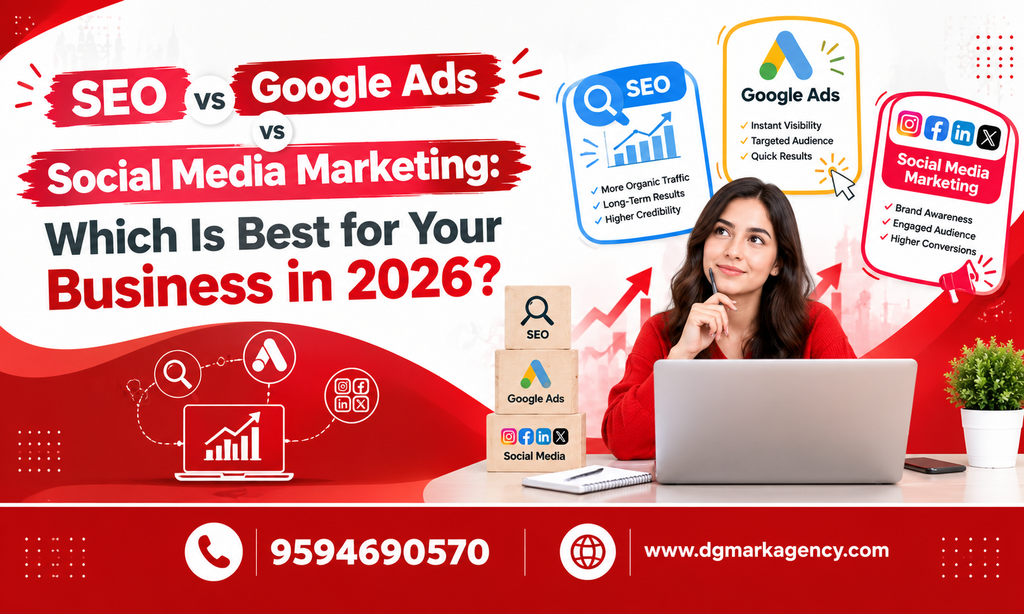
Search Engine Optimization (SEO), Google Ads, and social media marketing are three important digital marketing strategies that help businesses connect with potential customers. Although all three contribute to online growth, they operate differently. SEO focuses on improving organic search visibility, Google Ads helps businesses reach users through paid advertising, and social media marketing strengthens brand awareness, customer engagement, and online relationships.
For startups, small businesses, and established companies, understanding these differences is essential before investing in digital marketing services. A business looking for immediate enquiries may have different marketing requirements from one planning sustainable organic growth. Similarly, a company targeting local customers may need a different approach from an organization serving audiences across multiple cities.
As a digital marketing company in Mumbai, DGmark Agency understands the importance of selecting marketing channels according to business objectives, industry competition, target audiences, and customer behaviour. A well-planned strategy should focus on attracting relevant visitors, creating meaningful interactions, and converting potential customers into genuine business opportunities.
This comprehensive guide compares SEO, Google Ads, and social media marketing in 2026, covering their benefits, limitations, costs, lead-generation potential, long-term value, and suitability for different businesses.
What Is the Difference Between SEO, Google Ads, and Social Media Marketing?
SEO, Google Ads, and social media marketing are different approaches to reaching potential customers online. While SEO helps businesses become visible through unpaid search results, Google Ads allows advertisers to reach targeted audiences through paid placements. Social media marketing focuses on building brand awareness, engaging users, and encouraging customer interactions across digital platforms.
Understanding how these channels work helps businesses develop more effective marketing strategies rather than selecting services based only on popularity.
Search Engine Optimization (SEO)
SEO involves improving a website’s content, technical structure, and overall search relevance to increase its visibility in organic search results.
Important SEO activities include:
- Keyword research based on user search intent.
- On-page optimization of titles, headings, and content.
- Technical improvements to website accessibility and performance.
- Creation of informative, relevant website content.
- Local search optimization for location-based businesses.
- Development of genuine industry authority and relevant backlinks.
- Monitoring organic traffic, rankings, and conversions.
SEO is generally suitable for businesses aiming to develop long-term online visibility.
Google Ads
Google Ads is a paid advertising platform that helps businesses reach users through relevant advertisements across Google’s advertising network.
Its major features include:
- Keyword-based search campaigns.
- Geographic and audience targeting.
- Flexible campaign budget management.
- Conversion tracking and performance measurement.
- Campaign optimization using audience and conversion signals.
- Advertising formats suitable for different marketing objectives.
Google Ads is particularly useful when businesses want to reach customers already searching for specific products or services.
Social Media Marketing
Social media marketing uses platforms such as Instagram, Facebook, LinkedIn, and YouTube to reach audiences through organic content and paid advertising.
Its main activities include:
- Social media content planning and publishing.
- Brand storytelling and visual communication.
- Reels, videos, carousels, and educational posts.
- Community engagement and customer interactions.
- Paid social advertising campaigns.
- Social media performance analysis.
Each marketing channel plays a different role. Businesses can achieve more balanced growth when they understand these differences and select strategies according to their objectives.
How Does SEO Help Businesses Grow Organically in 2026?
SEO helps businesses improve their visibility when potential customers search for relevant products, services, or information online. Unlike paid advertising, organic website traffic does not involve paying for individual search clicks. However, SEO requires consistent investment in content development, technical improvements, website optimization, and performance monitoring.
In 2026, effective SEO focuses on understanding user intent, producing useful information, improving website experiences, and ensuring search engines can access and interpret website content.
Important Elements of an Effective SEO Strategy
- Keyword research: Identifying search phrases that match customer needs and commercial intent.
- On-page SEO: Optimizing page titles, headings, meta descriptions, and relevant website content.
- Technical SEO: Improving crawlability, indexing, mobile responsiveness, and website performance.
- Content marketing: Developing articles, service pages, and educational resources that answer customer questions.
- Local SEO: Improving visibility for businesses targeting specific geographical locations.
- Website structure: Organizing content logically so visitors can find relevant information.
- Authority development: Building industry credibility through useful content and legitimate references.
- Conversion optimization: Encouraging relevant visitors to submit enquiries, request consultations, or complete purchases.
Why Organic Visibility Matters for Businesses
Organic search visibility allows businesses to reach potential customers during different stages of their buying journey.
For example, a user might initially search for information about digital marketing strategies before comparing service providers. A business publishing useful content that answers these questions may attract relevant visitors and establish credibility before the customer makes a final decision.
SEO supports this process by connecting search queries with relevant website content. Although rankings and traffic can fluctuate, a well-maintained SEO strategy can strengthen long-term business visibility.
How Do Google Ads Help Businesses Generate Leads and Sales?
Google Ads helps businesses display paid advertisements to audiences searching for products, services, and solutions online. It provides opportunities to reach potential customers based on search terms, location, campaign settings, and other relevant signals.
One important advantage of Google Ads is the ability to launch targeted campaigns without waiting for organic search rankings to improve. However, advertising success depends on campaign planning, relevant targeting, landing page quality, and ongoing optimization.
How Google Ads Supports Lead Generation
- High-intent keyword targeting: Reach users searching for specific products or services.
- Location targeting: Focus advertisements on relevant cities or business service areas.
- Campaign flexibility: Adjust campaign settings according to marketing objectives.
- Conversion tracking: Measure enquiries, calls, purchases, and valuable customer actions.
- Landing page optimization: Direct visitors toward relevant service information and enquiry options.
- Audience insights: Evaluate how different audience groups interact with advertisements.
- Performance optimization: Refine campaigns based on search terms, conversions, and lead quality.
Why Landing Pages Matter in Google Ads
A successful advertising campaign requires more than attracting clicks. Visitors should reach a page that matches their original search and provides useful information.
An effective landing page should include:
- A clear headline that matches the advertisement.
- Relevant product or service information.
- Important business benefits.
- Trust-building information.
- Simple contact or enquiry options.
- Mobile-friendly navigation.
- Clear calls to action.
Google Ads can be valuable for businesses seeking targeted enquiries, particularly when potential customers already know what they want. However, generating traffic does not automatically guarantee conversions, making ongoing testing essential.
How Does Social Media Marketing Help Businesses Build Brand Awareness and Engagement?
Social media marketing allows businesses to connect with potential customers through content, communication, and meaningful interactions. While search-based marketing often captures existing customer demand, social media can introduce a brand to people who may not yet be actively looking for its products or services.
Businesses can use social media platforms to communicate their expertise, demonstrate products, share useful information, and develop stronger relationships with their audiences.
Key Benefits of Social Media Marketing
- Brand awareness: Introduces businesses to relevant online audiences.
- Customer engagement: Encourages conversations through comments, messages, and interactions.
- Visual communication: Uses graphics, videos, reels, and carousels to explain services.
- Brand credibility: Helps businesses demonstrate their knowledge and professional approach.
- Audience education: Answers common questions and provides useful information.
- Community development: Encourages ongoing connections with customers and followers.
- Lead generation: Supports enquiries through relevant content, advertising, and website traffic.
- Customer relationships: Maintains brand visibility before and after purchases.
Choosing the Right Social Media Platform
Different platforms are suitable for different business requirements.
- Instagram: Useful for visual branding, creative content, reels, and product discovery.
- Facebook: Supports community engagement, business awareness, and advertising.
- LinkedIn: Relevant for professional networking, B2B marketing, and business expertise.
- YouTube: Supports educational videos, demonstrations, tutorials, and long-form content.
Social media success should not be measured only through follower counts. Businesses should also evaluate audience relevance, engagement quality, website visits, enquiries, and conversions.
SEO vs Google Ads vs Social Media Marketing: Which Delivers Better Results?
There is no universal winner when comparing SEO, Google Ads, and social media marketing. Each channel performs differently depending on the business model, marketing objective, customer behaviour, and available resources.
SEO may be suitable for businesses prioritizing organic search visibility, Google Ads can support targeted lead generation, and social media marketing is useful for building awareness and customer relationships.
SEO vs Google Ads vs Social Media Marketing Comparison
| Factors | SEO | Google Ads | Social Media Marketing |
|---|---|---|---|
| Main objective | Organic visibility | Targeted paid traffic | Awareness and engagement |
| Initial visibility | Gradual | Often faster | Depends on strategy |
| Traffic source | Organic search | Paid advertisements | Organic and paid social |
| Marketing investment | Ongoing optimization | Advertising and management | Content and optional advertising |
| Lead-generation potential | Strong for relevant searches | Strong for high-intent campaigns | Depends on audience and offer |
| Brand awareness | Builds through search discovery | Supports targeted exposure | Strong audience discovery opportunities |
| Long-term value | Builds organic content assets | Requires ongoing campaign management | Builds audience relationships |
| Suitable businesses | Most searchable products and services | Businesses with relevant customer demand | Consumer and professional brands |
How to Identify the Best-Performing Channel
Businesses should compare performance using:
- Qualified website visitors.
- Genuine customer enquiries.
- Lead-to-customer conversion rates.
- Customer acquisition costs.
- Revenue generated from marketing.
- Customer retention and repeat business.
- Overall marketing profitability.
The most effective channel is not necessarily the one generating the highest traffic. It is the one contributing meaningful results to the business.
Which Is Better for Small Businesses: SEO, Google Ads, or Social Media Marketing?
Small businesses need digital marketing strategies that balance available resources with realistic growth objectives. Since marketing budgets and internal capabilities are often limited, selecting the most relevant channels is particularly important.
A business that depends on local search enquiries may prioritize SEO and Google Ads, while a visually focused brand might benefit more from social media marketing.
Factors Small Businesses Should Consider
- Business objectives: Determine whether the main priority is awareness, enquiries, or sales.
- Customer search behaviour: Understand how potential customers look for products and services.
- Available resources: Evaluate the time, skills, and budget required for consistent marketing.
- Competition: Study how competing businesses attract and engage customers.
- Marketing timeline: Consider whether immediate visibility or long-term growth is more important.
- Website readiness: Ensure the website provides clear information and conversion opportunities.
- Audience preferences: Identify which digital platforms potential customers actively use.
Recommended Strategy for Different Small Businesses
Local service providers: Local SEO and targeted Google Ads can help attract customers searching for nearby services.
Retail and lifestyle businesses: Social media marketing can support visual discovery and customer engagement.
Professional service companies: SEO, Google Search campaigns, and LinkedIn marketing can support relevant lead generation.
Newly established businesses: A combination of foundational SEO and focused promotional activities may help establish visibility.
Small businesses should avoid investing in multiple platforms without a clear strategy. Starting with relevant channels and expanding based on performance is generally more practical.
Which Digital Marketing Channel Generates the Most Leads and Conversions?
Generating leads is an important objective for businesses investing in digital marketing services. However, lead quality matters more than simply collecting large numbers of enquiries.
SEO, Google Ads, and social media marketing can all contribute to lead generation, but their effectiveness depends on customer intent, targeting accuracy, campaign quality, and the business’s ability to convert enquiries into customers.
Lead Generation Through SEO
SEO can attract potential customers searching for solutions, services, or useful business information.
Important factors include:
- Commercially relevant keywords.
- Optimized service landing pages.
- Informative content addressing customer questions.
- Clear enquiry forms and contact details.
- Location-specific search visibility.
- Positive website experiences.
Lead Generation Through Google Ads
Google Ads can help businesses reach users who demonstrate purchasing interest through their searches.
Important factors include:
- High-intent keyword selection.
- Relevant advertisements.
- Suitable geographic targeting.
- Effective landing pages.
- Accurate conversion tracking.
- Continuous campaign optimization.
Lead Generation Through Social Media Marketing
Social media can generate enquiries through educational content, audience engagement, and targeted paid campaigns.
Important factors include:
- Audience-focused content.
- Clear brand communication.
- Relevant advertising offers.
- Engaging videos and creatives.
- Consistent customer interactions.
- Appropriate calls to action.
Businesses should evaluate qualified leads, customer acquisition costs, and actual conversions instead of choosing channels solely on enquiry volume.
Which Is More Cost-Effective: SEO, Google Ads, or Social Media Marketing?
The cost-effectiveness of digital marketing depends on the relationship between marketing investment and actual business results. Every channel involves different operational requirements, and businesses should evaluate the complete investment rather than focusing only on advertising expenses.
SEO requires ongoing optimization and content development. Google Ads involves advertising expenditure and campaign management. Social media marketing requires creative resources, content planning, community management, and potentially paid promotion.
Cost Factors in SEO
- Website audits and technical optimization.
- Keyword research and competitor analysis.
- Content writing and updates.
- Website improvements.
- Local search optimization.
- Performance reporting and maintenance.
Cost Factors in Google Ads
- Advertising campaign management.
- Keyword research.
- Ad creative development.
- Landing page preparation.
- Conversion tracking.
- Campaign monitoring and optimization.
Cost Factors in Social Media Marketing
- Content strategy development.
- Graphic design and video creation.
- Post scheduling and publishing.
- Community management.
- Paid social advertising.
- Reporting and performance analysis.
Which Strategy Provides Better Value?
SEO can create lasting content assets that continue attracting relevant visitors. Google Ads offers controlled access to paid traffic, while social media helps businesses develop brand familiarity and ongoing engagement.
The most cost-effective strategy depends on actual customer acquisition performance, not simply which channel appears less expensive.
Which Digital Marketing Strategy Offers the Best ROI in 2026?
Return on Investment measures the financial value a business receives from its marketing activities compared with the resources invested. In 2026, businesses should focus on meaningful performance indicators rather than relying only on rankings, impressions, clicks, or social media followers.
Although SEO, Google Ads, and social media marketing can contribute to revenue, each may influence the customer journey differently.
Important Metrics for Measuring Marketing ROI
- Qualified leads: Enquiries from potential customers who match business requirements.
- Conversion rate: Percentage of visitors completing desired actions.
- Customer acquisition cost: Resources required to acquire a new customer.
- Revenue attribution: Sales associated with particular marketing activities.
- Customer lifetime value: Long-term business value generated by customer relationships.
- Lead quality: Relevance and purchasing readiness of enquiries.
- Engagement quality: Whether interactions indicate genuine interest.
- Marketing efficiency: Relationship between investment and measurable business outcomes.
How Different Channels Contribute to ROI
SEO: Can support long-term value through organic visibility and relevant traffic.
Google Ads: Can generate measurable results when campaigns attract customers at sustainable acquisition costs.
Social Media Marketing: Can contribute through brand awareness, customer engagement, enquiries, and repeat interactions.
Since customers may interact with multiple channels before purchasing, businesses should evaluate overall marketing performance rather than assigning every result to the final platform visited.
How Long Does It Take to See Results from SEO, Google Ads, and Social Media Marketing?
The timeline for digital marketing results varies according to industry competition, website performance, campaign quality, and customer behaviour.
Some activities can generate initial visibility quickly, while others require ongoing development before meaningful improvements become apparent.
SEO Results Timeline
SEO generally requires sustained effort because search visibility depends on multiple factors.
Progress may involve:
- Website technical improvements.
- Search engine crawling and indexing.
- Content relevance improvements.
- Organic keyword visibility.
- Growth in qualified organic traffic.
- Better enquiry and conversion opportunities.
Meaningful progress often takes several months, although exact timelines cannot be guaranteed.
Google Ads Results Timeline
Google Ads campaigns can begin receiving traffic after activation and approval.
However, consistent performance may require:
- Keyword testing.
- Advertisement improvements.
- Audience refinement.
- Landing page optimization.
- Conversion tracking validation.
- Campaign performance analysis.
Early traffic should not be confused with established campaign profitability.
Social Media Marketing Results Timeline
Social media results depend on publishing consistency, audience engagement, and content relevance.
Progress may include:
- Improved content reach.
- Audience interactions.
- Follower growth.
- Profile visits.
- Website traffic.
- Customer enquiries.
- Stronger brand familiarity.
Businesses should establish realistic performance expectations and evaluate results over suitable periods.
Is SEO Better Than Google Ads for Long-Term Business Growth?
SEO can be particularly useful for businesses focused on building a sustainable online presence. By improving website structure, publishing relevant content, and targeting meaningful customer searches, businesses can develop organic visibility that supports continued discovery.
Google Ads, on the other hand, allows businesses to reach relevant audiences through paid advertising and can support immediate campaign objectives.
Advantages of SEO for Long-Term Growth
- Builds visibility across relevant organic searches.
- Supports content-driven customer discovery.
- Strengthens website structure and usability.
- Creates reusable content assets.
- Helps businesses target informational and commercial search intent.
- Supports local search discovery.
- Can reduce dependence on individual paid clicks over time.
Advantages of Google Ads for Business Growth
- Helps businesses reach targeted search audiences.
- Supports new service launches.
- Allows flexible campaign adjustments.
- Provides measurable advertising performance data.
- Helps test customer demand and messaging.
- Supports seasonal promotions.
- Can complement existing organic visibility.
SEO is often valuable as a long-term investment, but it requires maintenance and does not guarantee permanent rankings. Google Ads remains useful when paid customer acquisition is financially sustainable.
Businesses can benefit from using both strategies according to their goals.
Are Google Ads Worth It for Small Businesses in 2026?
Google Ads can be a valuable marketing channel for small businesses that understand their target customers and have a clear conversion strategy.
However, advertising effectiveness depends on more than launching campaigns. Businesses must ensure their products or services meet genuine market demand, their advertising reaches relevant users, and their websites provide a smooth customer experience.
When Google Ads May Be Suitable
- When customers actively search for the business’s services.
- When the company needs visibility for a newly launched offering.
- When advertising can target relevant geographical locations.
- When the business has clearly defined conversion objectives.
- When landing pages provide useful service information.
- When customer acquisition costs can be monitored.
- When the sales team can respond effectively to enquiries.
Common Google Ads Mistakes to Avoid
- Selecting overly broad or irrelevant keywords.
- Sending visitors to unrelated website pages.
- Ignoring conversion tracking.
- Failing to review actual search terms.
- Using unclear advertising messages.
- Not considering customer acquisition costs.
- Making campaign decisions without sufficient data.
Google Ads should be viewed as a performance-driven marketing channel that requires strategic management and continuous improvement.
Which Digital Marketing Strategy Is Best for Startups and New Businesses?
Startups often need to establish awareness, attract early customers, and validate demand while managing limited resources. Their digital marketing strategy should therefore prioritize activities that support meaningful business outcomes.
A startup does not necessarily need every available marketing channel immediately. Instead, it should focus on platforms that are most relevant to its audience and growth stage.
Essential Digital Marketing Activities for Startups
- Market research: Understand customer needs, competitors, and industry demand.
- Website development: Establish a professional digital presence.
- Basic SEO: Optimize important website pages for relevant searches.
- Google Ads: Test customer demand through focused advertising campaigns.
- Social media marketing: Introduce the brand and communicate its value.
- Content marketing: Answer customer questions and demonstrate expertise.
- Conversion optimization: Make it easy for visitors to contact or purchase from the business.
- Performance measurement: Identify activities that generate qualified business opportunities.
Recommended Approach for New Businesses
Initially, startups should focus on creating a strong website, clear brand messaging, and relevant search visibility.
Once foundational activities are established, paid advertising and social media campaigns can help test audience response and increase awareness.
As performance data becomes available, businesses can expand successful activities while reducing ineffective marketing efforts.
Which Marketing Channel Works Best for Local Businesses in Mumbai?
Mumbai is a competitive business environment where companies across industries compete for customer attention and online visibility. Businesses targeting local audiences need strategies that reflect geographical relevance, customer search behaviour, and service availability.
Local SEO, targeted Google Ads, and location-relevant social media marketing can support businesses serving customers across Andheri, Borivali, Bandra, Goregaon, Malad, and other Mumbai locations.
Local SEO for Mumbai Businesses
Local SEO helps companies become more discoverable through relevant location-based searches.
Important activities include:
- Google Business Profile optimization.
- Accurate business information.
- Location-specific keyword research.
- Relevant local service pages.
- Customer review management.
- Mobile-friendly website optimization.
- Consistent business information across legitimate listings.
Google Ads for Local Lead Generation
Google Ads can help companies reach customers searching for relevant services within selected geographical areas.
Businesses can focus on:
- City-specific campaigns.
- Service-area targeting.
- Location-relevant search terms.
- Local landing pages.
- Call and enquiry conversion tracking.
- Campaign performance by geographical area.
Social Media Marketing for Local Brand Awareness
Social platforms can help businesses communicate with audiences through location-relevant content.
Useful strategies include:
- Locally relevant posts.
- Community-focused content.
- Customer experiences.
- Location-specific paid campaigns.
- Educational videos and reels.
- Local audience engagement.
Businesses searching for a digital marketing agency in Andheri may prioritize local search visibility, targeted advertising, and lead-generation capabilities.
Similarly, organizations considering a digital marketing agency in Borivali may look for support with improving online discovery and reaching customers across nearby business areas.
The ideal local strategy should match the business’s service coverage and customer requirements rather than targeting locations without genuine relevance.
Should Businesses Use SEO, Google Ads, and Social Media Marketing Together?
SEO, Google Ads, and social media marketing can complement each other when businesses use them as part of an integrated digital marketing strategy.
Instead of treating each platform as an isolated activity, businesses can connect search visibility, paid customer acquisition, and social engagement to create a more consistent customer journey.
Benefits of an Integrated Digital Marketing Strategy
- Wider audience reach: Connect with potential customers across different digital platforms.
- Consistent brand communication: Maintain clear messaging throughout marketing activities.
- Improved customer discovery: Increase opportunities for relevant audiences to find the business.
- Multiple conversion opportunities: Support enquiries through search, advertising, and social engagement.
- Better customer understanding: Gather performance insights from different interactions.
- Coordinated marketing campaigns: Align content, advertising, and website activities.
- Long-term brand development: Balance immediate lead-generation efforts with sustainable visibility.
How the Three Channels Work Together
SEO creates organic discovery opportunities.
Useful service pages and informational content help customers find relevant business information.
Google Ads captures targeted demand.
Paid campaigns can connect with potential customers searching for specific solutions.
Social media develops audience relationships.
Consistent content helps businesses communicate their expertise and maintain customer engagement.
Together, these channels can support a more connected marketing strategy when supported by clear business goals, appropriate resources, and consistent measurement.
How Is AI Changing SEO, Google Ads, and Social Media Marketing in 2026?
Artificial Intelligence is influencing how businesses approach content creation, audience targeting, advertising optimization, and online visibility.
In 2026, AI-supported search experiences and automated marketing tools have made it increasingly important for businesses to focus on accurate information, relevant content, and meaningful customer experiences.
AI in Search Engine Optimization
AI-related developments are influencing how users discover and evaluate information.
Important considerations include:
- Creating content that answers real customer questions.
- Using clear headings and logical website structures.
- Providing accurate and useful business information.
- Demonstrating relevant knowledge and expertise.
- Maintaining technically accessible websites.
- Developing original content rather than repetitive AI-generated material.
Where useful, businesses can also consider Answer Engine Optimization and Generative Engine Optimization principles to make important information easier to interpret and summarize.
AI in Google Ads
Google Ads uses automated systems and machine learning to support advertising processes.
Relevant applications include:
- Automated bidding.
- Campaign performance optimization.
- Audience signal analysis.
- Advertisement asset testing.
- Conversion-based optimization.
- Campaign reporting and insights.
Automation can assist campaign management, but accurate tracking and human oversight remain important.
AI in Social Media Marketing
AI-assisted tools can support creative and operational marketing tasks.
Examples include:
- Content topic research.
- Caption drafting.
- Creative concept development.
- Audience insight analysis.
- Video production assistance.
- Performance reporting.
- Content scheduling support.
AI should improve the efficiency of marketing workflows rather than replace original thinking, brand expertise, or human quality control.
Businesses that combine useful technology with a clear understanding of their audiences are better positioned to adapt to changing digital marketing practices.
How Can Businesses Choose the Right Digital Marketing Services for Their Goals?
Choosing digital marketing services requires more than comparing popular platforms. Businesses need to evaluate their objectives, audience behaviour, current online presence, industry competition, and available resources.
A suitable marketing strategy should connect business priorities with activities that can be measured and improved.
Identify Your Primary Business Objective
Begin by determining what the business wants to achieve.
Common objectives include:
- Increasing website traffic.
- Improving search visibility.
- Generating qualified leads.
- Increasing online sales.
- Building brand awareness.
- Entering new geographical markets.
- Improving customer engagement.
- Strengthening customer retention.
Understand Your Target Audience
Different audiences respond to different marketing channels.
Important research areas include:
- Customer requirements.
- Search behaviour.
- Preferred social platforms.
- Geographical location.
- Purchasing motivations.
- Common customer questions.
- Decision-making processes.
Evaluate Existing Digital Performance
Before investing in new services, review current marketing activities.
This can include:
- Website performance.
- Organic search visibility.
- Paid advertising results.
- Social media engagement.
- Website conversion rates.
- Customer enquiry quality.
- Existing content effectiveness.
Choose Services According to Business Requirements
Businesses should consider:
- SEO for relevant organic visibility.
- Google Ads for targeted paid search opportunities.
- Social media marketing for brand awareness and engagement.
- Content marketing for customer education.
- Website optimization for improved visitor experiences.
- Local SEO for geographical search relevance.
- Conversion optimization for better enquiry opportunities.
A professional digital marketing company in Mumbai should be able to explain how these services contribute to specific business goals.
The right approach is not about investing in every platform. It is about selecting suitable marketing activities and improving them based on measurable business performance.
Why Choose DGmark Agency for Digital Marketing Services in Mumbai?
DGmark Agency provides digital marketing services for businesses seeking to improve their online presence, reach relevant audiences, and develop structured marketing strategies.
As a digital marketing company in Mumbai, DGmark Agency focuses on combining digital platforms and marketing techniques according to business requirements. Its services cover search engine optimization, Google Ads, social media marketing, website development, and other online marketing activities.
Comprehensive Digital Marketing Services
DGmark Agency supports different aspects of digital marketing, including:
- Search Engine Optimization: Improving website relevance, technical structure, and organic search visibility.
- Google Ads Management: Planning and optimizing targeted paid advertising campaigns.
- Social Media Marketing: Developing content strategies and managing audience engagement.
- Paid Social Advertising: Creating platform-specific campaigns for relevant customer segments.
- Website Development: Supporting professional, responsive, and user-friendly websites.
- Local SEO: Improving location-relevant online visibility.
- Content Marketing: Developing useful and relevant website and social media content.
- Digital Marketing Strategy: Coordinating different marketing activities according to business goals.
Understanding Local Business Requirements
Businesses operating in Mumbai face different customer requirements and competitive conditions depending on their location and industry.
DGmark Agency’s location-focused service presence makes it relevant for organizations searching for a digital marketing agency in Andheri and businesses exploring a digital marketing agency in Borivali.
Important aspects of location-focused marketing include:
- Understanding local customer search behaviour.
- Identifying relevant geographical keywords.
- Developing location-specific marketing strategies.
- Creating suitable advertising audiences.
- Strengthening business visibility through relevant local content.
- Maintaining consistent brand messaging.
- Evaluating lead quality and campaign performance.
Strategy Based on Business Objectives
Effective digital marketing requires continuous evaluation and improvement.
A structured approach involves:
- Understanding business requirements.
- Reviewing the existing digital presence.
- Identifying suitable marketing opportunities.
- Selecting relevant platforms.
- Developing campaigns and content.
- Monitoring performance indicators.
- Refining activities based on results.
Rather than relying on a single marketing channel, businesses can evaluate how different digital marketing services support their customer acquisition and brand development objectives.
For organizations aiming to improve search visibility, advertising performance, or customer engagement, DGmark Agency offers an integrated service approach designed around practical digital marketing requirements.
Frequently Asked Questions (FAQs)
1. Is SEO or Google Ads Better for Small Businesses in 2026?
SEO is generally suitable for small businesses wanting to develop organic search visibility over time. Google Ads can help businesses reach targeted customers more quickly through paid advertising. The better option depends on customer demand, competition, marketing resources, and business objectives. Companies can also combine both strategies when appropriate.
2. Can Google Ads Generate Leads Faster Than SEO?
Google Ads can start bringing relevant traffic shortly after campaigns are approved and activated. SEO generally takes longer to develop meaningful organic visibility. However, qualified lead generation depends on advertising relevance, website quality, customer demand, and conversion optimization. Neither strategy guarantees immediate enquiries or sales.
3. Is Social Media Marketing Better Than SEO for Business Growth?
Social media marketing is effective for brand awareness, engagement, and customer relationships, while SEO improves visibility for relevant search queries. Businesses should select channels according to audience behaviour and marketing objectives. Using both can support different stages of the customer journey.
4. How Much Should a Small Business Spend on Digital Marketing in 2026?
Digital marketing investment depends on business goals, profit margins, competition, and customer acquisition requirements. Businesses should evaluate the complete cost of content creation, website optimization, advertising, and campaign management. A focused strategy with measurable objectives is generally more useful than spreading resources across unrelated activities.
5. Can Businesses Rank on Google Without Running Paid Ads?
Yes. Businesses can appear in Google’s organic search results without paying for advertisements. Organic visibility depends on factors such as website accessibility, content relevance, technical optimization, and search competition. Google Ads spending does not directly improve organic search rankings.
6. Which Digital Marketing Channel Is Best for B2B Lead Generation?
B2B businesses may benefit from SEO, Google Search campaigns, and LinkedIn marketing. SEO supports research-based discovery, Google Ads can help reach audiences searching for specific solutions, and LinkedIn supports professional communication. The best combination depends on the industry, target decision-makers, and purchasing process.
7. Does SEO Still Work in 2026 with AI-Powered Search?
Yes. SEO remains important because search engines and AI-powered experiences still depend on accessible, relevant, and useful information. Businesses should prioritize clear content, original expertise, technical website quality, and accurate business details. AI-related optimization can complement foundational SEO practices but does not guarantee visibility in generated answers.
8. Can SEO, Google Ads, and Social Media Marketing Work Together?
Yes. SEO supports organic visibility, Google Ads can attract targeted paid traffic, and social media marketing can strengthen audience relationships. Combining these channels can create a more consistent customer experience when supported by relevant content, suitable landing pages, and effective performance tracking.
9. Which Is Better for Local Businesses in Mumbai: SEO or Google Ads?
Local SEO can help businesses develop visibility in relevant organic and local search results. Google Ads can provide targeted advertising opportunities for customers searching within selected geographical areas. Mumbai businesses should evaluate customer demand, service coverage, competition, and budget before choosing their strategy.
10. How Do I Choose the Right Digital Marketing Agency in Mumbai?
Businesses should review an agency’s service capabilities, relevant experience, strategic approach, reporting practices, and communication process. A suitable agency should understand business objectives, explain appropriate marketing channels, and establish realistic performance expectations. Comparing proposed strategies and measurable goals can help businesses make informed decisions.
Conclusion
SEO, Google Ads, and social media marketing each play an important role in helping businesses improve online visibility, attract relevant audiences, and generate business opportunities in 2026. SEO supports organic discovery and long-term website development, Google Ads provides targeted paid advertising opportunities, and social media marketing helps businesses strengthen brand awareness and customer engagement. The most suitable strategy depends on customer behaviour, industry competition, available resources, and specific business objectives. Rather than choosing a channel based only on popularity, businesses should evaluate its ability to generate qualified leads, support customer relationships, and contribute to sustainable growth.
For businesses looking to strengthen their digital presence, DGmark Agency provides SEO, Google Ads, social media marketing, website development, and integrated digital marketing solutions. As businesses across Mumbai continue adapting to changing customer expectations and online search behaviour, combining relevant marketing channels with clear objectives and regular performance analysis can support stronger digital strategies. Whether the priority is improving organic visibility, reaching new audiences, or generating meaningful enquiries, a balanced and well-managed approach can help businesses build a more effective online presence in 2026 and beyond.
Contact DGmark Agency Today!
DGmark Agency – Best Digital Marketing Agency in Andheri, Mumbai
Address– 405, 4th Floor, Pratik, Ratan Nagar Apartment-B Wing, Bus Stop, Near, Apna Bazar Rd, opp. Dhake Colony, D.N.Nagar, Andheri West, Mumbai, Maharashtra 400053
Phone no. – 9594690570
Website: https://dgmarkagency.com/